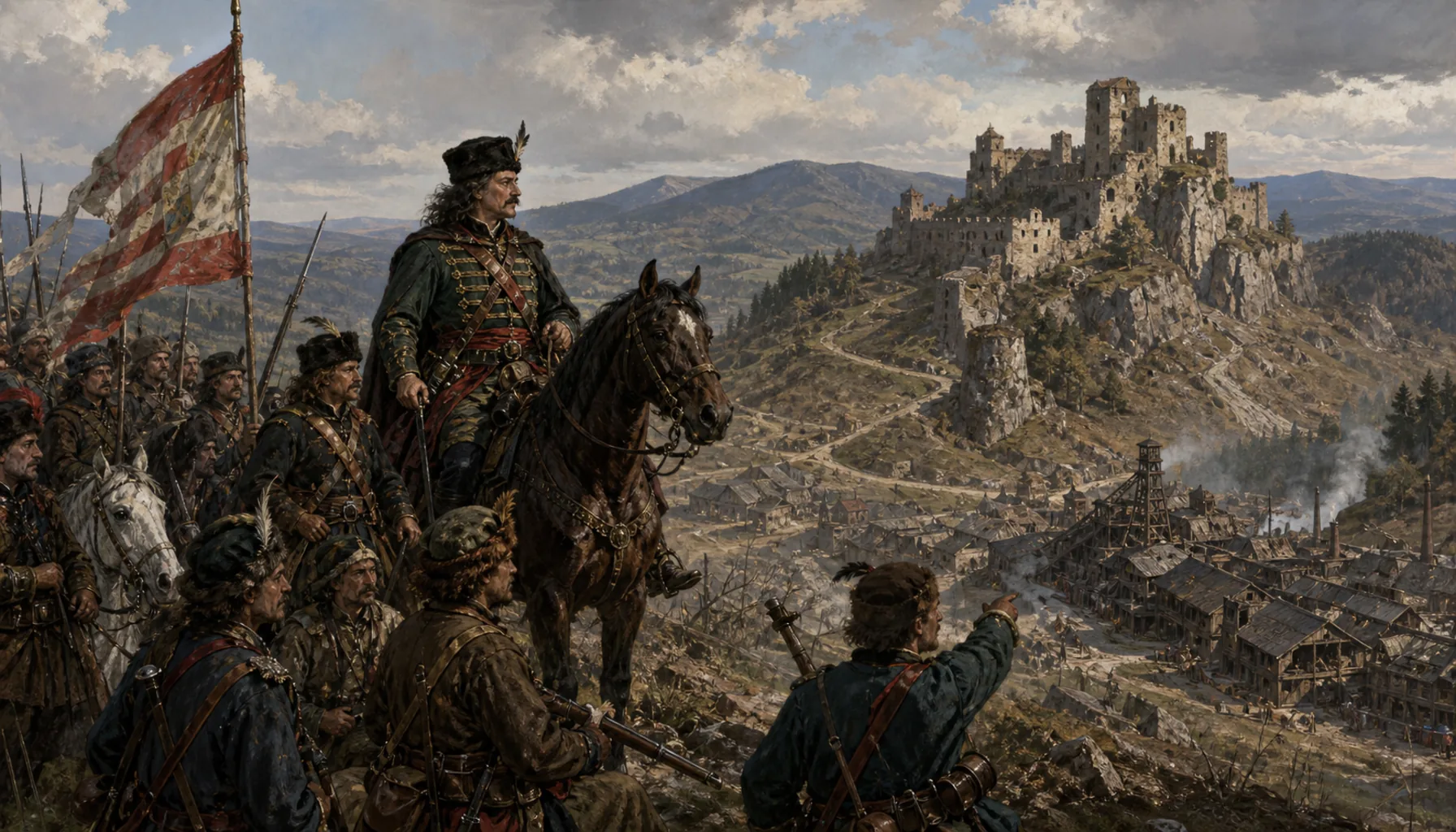
1703 – 1711Rákóczi's war, and why so many castles are ruinsRákociho vojna a prečo je toľko hradov v ruinách
SlovakiaSlovensko
Rákóczi's war, and why so many castles are ruinsRákociho vojna a prečo je toľko hradov v ruinách
The last and largest of the risings began on 6 May 1703 under Francis II Rákóczi, and for years his kuruc armies held most of today's Slovakia, including the mining towns whose silver paid for the war. A diet at Ónod declared the Habsburgs deposed in June 1707, but on 3 August 1708 the kuruc army was broken at Trenčín, losing some three thousand men, and never recovered; plague arriving in 1709 killed hundreds of thousands more. The Peace of Szatmár of 30 April 1711 ended the fighting on terms that pardoned the rebels and left the Habsburgs on the throne. Afterwards imperial commanders systematically blew up or pulled down castles a rebel garrison might use again — which is the real reason so many Slovak castles are ruins today, and why 'the Turks destroyed it' is so often the wrong answer.Posledné a najväčšie povstanie sa začalo 6. mája 1703 pod vedením Františka II. Rákociho a jeho kurucké vojská roky ovládali väčšinu dnešného Slovenska vrátane banských miest, ktorých striebro vojnu platilo. Snem v Ónode vyhlásil v júni 1707 Habsburgovcov za zosadených, no 3. augusta 1708 utrpeli kuruci pri Trenčíne porážku, v ktorej padlo asi tritisíc mužov, a už sa z nej nespamätali; mor, ktorý prišiel roku 1709, si vyžiadal ďalšie státisíce životov. Satmársky mier z 30. apríla 1711 boj ukončil: povstalcom dal milosť a Habsburgovcov nechal na tróne. Cisárski velitelia potom sústavne vyhadzovali do vzduchu a rozoberali hrady, ktoré by mohla znova obsadiť povstalecká posádka — a práve to je skutočný dôvod, prečo je dnes na Slovensku toľko zrúcanín a prečo je odpoveď „zbúrali to Turci“ tak často nesprávna.
ReferencesZdroje
Where this came fromOdkiaľ to pochádza
Sources consulted while researching this page. Follow them to read further — and to check us.Zdroje, z ktorých sme pri príprave tejto stránky vychádzali. Kliknite a čítajte ďalej — aj si nás overte.
Černová massacre — Wikipediadate, 15 killed and 12 seriously wounded, gendarmes' own nationalitydate, 15 killed and 12 seriously wounded, gendarmes' own nationality
Magyarization — Wikipediathe 1907 Apponyi education laws, the closing of the Slovak grammar schools and of Matica slovenská in April 1875the 1907 Apponyi education laws, the closing of the Slovak grammar schools and of Matica slovenská in April 1875
Žiadosti slovenského národa — Wikipédia10 May 1848, fourteen points, the arrest warrants of May–June 184810 May 1848, fourteen points, the arrest warrants of May–June 1848
Slovak Uprising of 1848–49 — Wikipediathe three volunteer campaigns and the disbanding of the corps on 21 November 1849the three volunteer campaigns and the disbanding of the corps on 21 November 1849
Pittsburgh Agreement — Wikipediathe Cleveland Agreement of 22 October 1915 and the text of the Pittsburgh promisesthe Cleveland Agreement of 22 October 1915 and the text of the Pittsburgh promises
Slovak–Hungarian War — Wikipediathe 'Little War' of March 1939 and the 1,697 km² ceded on 4 April 1939the 'Little War' of March 1939 and the 1,697 km² ceded on 4 April 1939
Slovak National Uprising — Wikipediainsurgent numbers, territory held, the fall of Banská Bystrica on 27 October 1944insurgent numbers, territory held, the fall of Banská Bystrica on 27 October 1944
Kremnička and Nemecká massacres — Wikipedia747 victims at Kremnička, about 900 at Nemecká, the units responsible747 victims at Kremnička, about 900 at Nemecká, the units responsible
Masaker v Kľakovskej doline — Wikipédia21 January 1945, 148 civilians including 48 children under eighteen21 January 1945, 148 civilians including 48 children under eighteen
Battle of the Dukla Pass — Wikipedia8 September – 28 October 1944 and the casualty figures8 September – 28 October 1944 and the casualty figures
Kalinov — Wikipédiathe first village in Slovakia liberated, 21 September 1944the first village in Slovakia liberated, 21 September 1944
Slovak Greek Catholic Church — Wikipediathe staged Prešov assembly of April 1950, Bishop Gojdič, the 1968 restorationthe staged Prešov assembly of April 1950, Bishop Gojdič, the 1968 restoration