Banská Štiavnica · September processionBanská Štiavnica · septembrový sprievod
The Salamander ProcessionSalamandrový sprievod
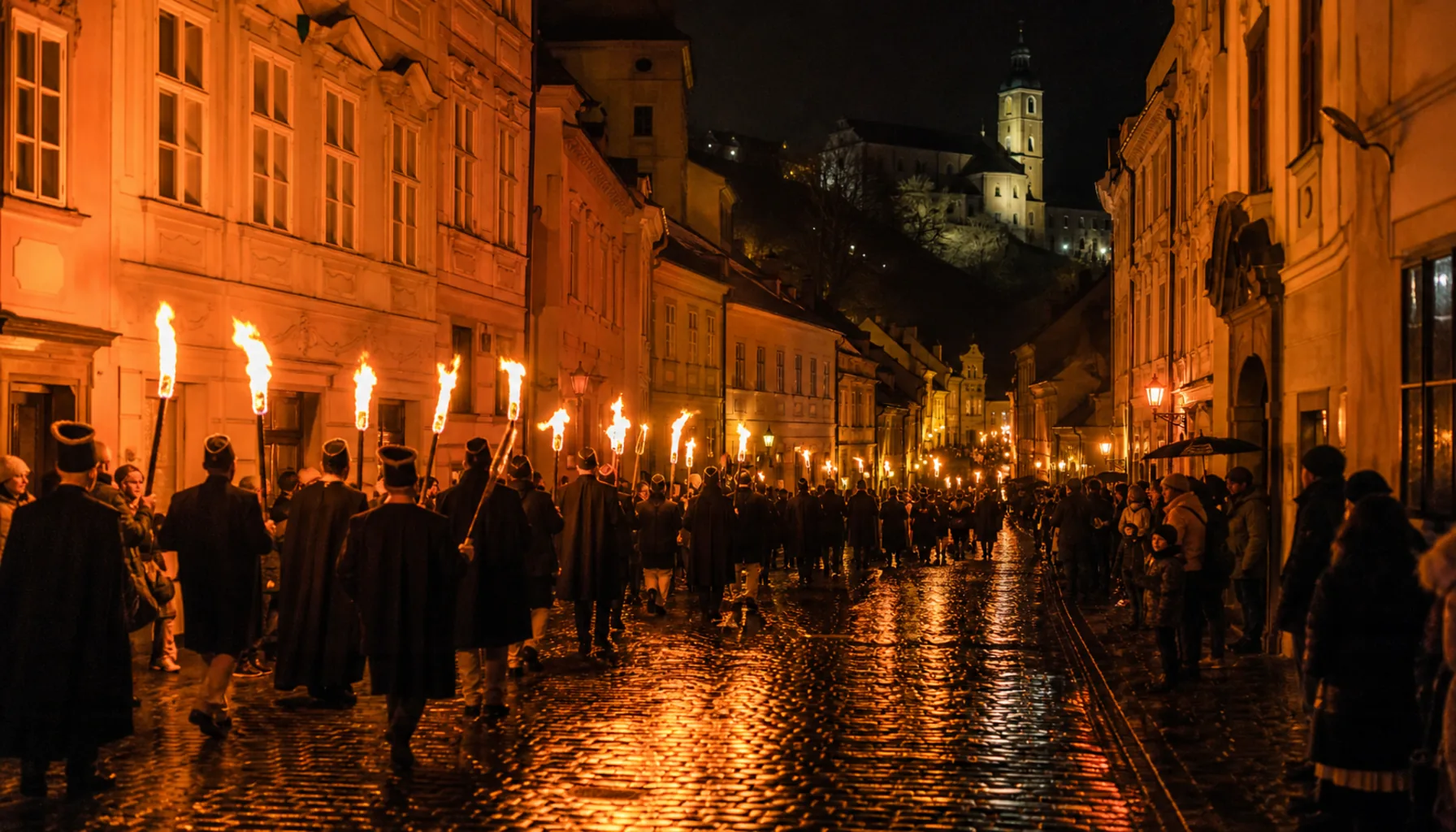
Each September, after dark, a line of torches and miners' lamps winds down through Banská Štiavnica — miners, students and costumed figures walking the streets of a UNESCO silver town in a tradition the mining academy began.Každý september sa po zotmení tiahne Banskou Štiavnicou reťaz fakieľ a baníckych kahancov — baníci, študenti a kostýmované postavy kráčajú ulicami strieborného mesta zapísaného v UNESCO v tradícii, ktorá sa začala na banskej akadémii.
Torches moving down the old mining town's main street after dark.Fakle schádzajú hlavnou ulicou starého banského mesta po zotmení.
Friday evening, after darkV piatok po zotmení
Salamandrové dni take over Banská Štiavnica in the second week of September, and the procession itself goes on the Friday evening, once it is properly dark. It comes down from the upper town through the tilted streets at walking pace, lit by torches and by the miners' own lamps.Salamandrové dni ovládnu Banskú Štiavnicu v druhom septembrovom týždni a samotný sprievod vychádza v piatok večer, keď sa poriadne zotmie. Z hornej časti mesta schádza šikmými uličkami pomaly, krok za krokom, osvetlený fakľami a baníckymi kahancami.
Nothing is hurried. Brass bands play between the groups, the crowd stands several deep on pavements barely wide enough for two, and the greeting heard all evening is Zdar Boh! — the miners' own, the words they used underground. The square sings the miners' anthem at the end.Nič sa tu neponáhľa. Medzi skupinami hrajú dychovky, ľudia stoja v niekoľkých radoch na chodníkoch sotva širokých pre dvoch a celý večer znie pozdrav Zdar Boh! — banícky, ten istý, ktorý znel pod zemou. Na záver zaznie na námestí banícka hymna.
Who walks in itKto v ňom kráča
The line is a cast, not a crowd. Miners walk in black dress uniform under the crossed hammer and chisel, guild banners above them; students of the old academy in period dress; children in costume make up the salamander itself, wriggling along in the middle.Sprievod nie je dav, ale obsadenie. Baníci kráčajú v čiernych parádnych uniformách pod skríženým kladivkom a želiezkom, nad nimi zástavy spolkov; študenti starej akadémie idú v dobových odevoch; deti v kostýmoch tvoria samotnú salamandru, ktorá sa v strede sprievodu vlní.
With them come the figures from the town's own stories — the shepherd Sebastián, who in the founding legend followed two lizards, one gold and one silver, to the ore, and Nácko, the slow-moving, quick-tongued miner of Štiavnica jokes, who is less a character than the town's idea of itself.Idú s nimi postavy z vlastných príbehov mesta — pastier Sebastián, ktorý podľa zakladateľskej povesti sledoval dve jašterice, zlatú a striebornú, až k rude, a Nácko, pomalý, ale rečou pohotový baník zo štiavnických vtipov, ktorý nie je ani tak postavou, ako predstavou mesta o sebe samom.
Where it comes fromOdkiaľ sa vzal
Maria Theresa founded a mining school here in 1762, the first of its kind anywhere, and for more than a century Europe came to Štiavnica to learn mining and forestry. The students had ceremonies of their own; the Salamander began as one of them.Mária Terézia tu v roku 1762 založila banskú školu, prvú svojho druhu na svete, a viac než storočie chodila celá Európa do Štiavnice študovať baníctvo a lesníctvo. Študenti mali vlastné obrady; salamander sa začal ako jeden z nich.
The academy left for Hungary after the First World War and the mines eventually closed. The procession outlived both — reworked in the twentieth century into the staged, costumed form it has now, and added to Slovakia's inventory of intangible cultural heritage in 2013.Akadémia sa po prvej svetovej vojne presťahovala do Maďarska a bane napokon zavreli. Sprievod prežil oboje — v 20. storočí ho prepracovali do dnešnej režírovanej, kostýmovanej podoby a v roku 2013 ho zapísali do slovenského zoznamu nehmotného kultúrneho dedičstva.
Where the name comes from is still argued over. Some point to the two lizards of the legend, some to an old student drinking ritual called a salamander, some simply to the shape — a long lit body crawling downhill, best seen from the other side of the valley.O pôvode názvu sa dodnes vedú spory. Jedni ukazujú na dve jašterice z povesti, iní na starý študentský pripíjací rituál zvaný salamander, ďalší jednoducho na tvar — dlhé svetelné telo, ktoré sa plazí dolu svahom a najlepšie ho vidno z druhej strany doliny.
The town it moves throughMesto, ktorým prechádza
Banská Štiavnica sits inside the bowl of an extinct volcano and has been on the UNESCO list since 1993. There is no flat ground: streets climb, houses stand on terraces cut into the slope, and the two castles face each other across the roofs.Banská Štiavnica leží v kotle vyhasnutej sopky a od roku 1993 je zapísaná v zozname UNESCO. Rovina tu nie je nikde: ulice stúpajú, domy stoja na terasách vysekaných do svahu a oba zámky si cez strechy hľadia do očí.
The town does half the work. The procession threads lanes barely wider than a cart, past the Renaissance houses of the mine owners, and ends on Trinity Square under its plague column; above it stands the Klopačka, the tower whose wooden clapper once woke the shift. Our page on Banská Štiavnica covers the town out of festival season.Polovicu práce urobí samo mesto. Sprievod sa vinie uličkami sotva širšími ako voz, popri renesančných domoch ťažiarov, a končí na Námestí svätej Trojice pod morovým stĺpom; nad ním stojí Klopačka, veža, ktorej drevené klopadlo kedysi budilo šichtu. Naša stránka o Banskej Štiavnici opisuje mesto aj mimo festivalovej sezóny.
If you goAk sa chystáte
Come for the weekend rather than the one evening. Salamander Days carry a fair, concerts and a national gathering of miners, metallurgists and geologists, and the mining fraternities hold their own formal ceremonies — rule-bound occasions that a visitor watches from the outside.Príďte radšej na celý víkend než na jediný večer. K Salamandrovým dňom patrí jarmok, koncerty a celoslovenské stretnutie baníkov, hutníkov a geológov; banícke spolky majú aj vlastné slávnostné obrady — podujatia s prísnymi pravidlami, ktoré návštevník sleduje zvonka.
The practicalities are unforgiving. The town is small, beds go months ahead, parking is limited and steeply below wherever you want to be, and September evenings in the Štiavnica Hills are cold. Find a spot looking down a lane — that is where the salamander looks like one.Praktické veci sú neúprosné. Mesto je malé, ubytovanie býva obsadené mesiace vopred, parkovania je málo a vždy strmo pod miestom, kam sa chcete dostať, a septembrové večery v Štiavnických vrchoch sú chladné. Nájdite si miesto s výhľadom dolu uličkou — práve odtiaľ salamandra vyzerá ako salamandra.