Two political emigrations in one lifetime — after 1948 and after 1968 — and then, after 2004, several hundred thousand people simply commuting to a job in another country.Dve politické emigrácie za jeden ľudský vek — po roku 1948 a po roku 1968 — a potom, po roku 2004, stovky tisíc ľudí, ktorí jednoducho dochádzajú za prácou do inej krajiny.
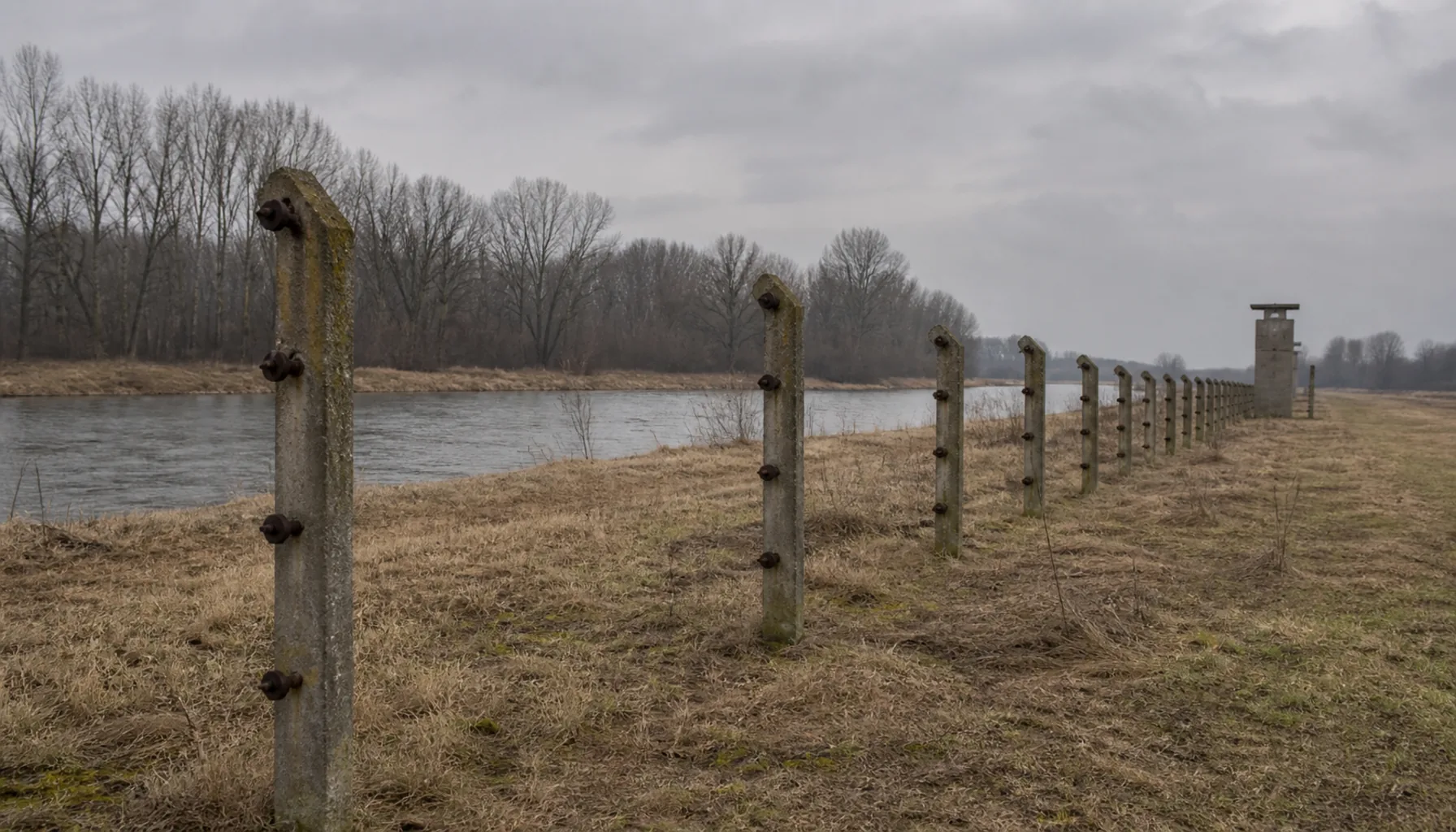
The remains of the Iron Curtain fence line along the MoravaZvyšky drôtenej zátarasy popri Morave
1948 and 1968Roky 1948 a 1968
The communist takeover in February 1948 produced the first modern political emigration: politicians, officers, clergy, business owners and students who left in months, mostly westwards across the Austrian border, and who could not return for forty years. A second and larger wave left after August 1968, when the Warsaw Pact invasion ended the Prague Spring; estimates of that one run well into six figures for Czechoslovakia as a whole.Komunistický prevrat vo februári 1948 priniesol prvú modernú politickú emigráciu: politikov, dôstojníkov, duchovných, podnikateľov a študentov, ktorí odišli v priebehu mesiacov, väčšinou na západ cez rakúsku hranicu — a nemohli sa vrátiť štyridsať rokov. Druhá a väčšia vlna odišla po auguste 1968, keď invázia vojsk Varšavskej zmluvy ukončila Pražskú jar; odhady tejto vlny idú za celé Československo hlboko do šesťciferných čísel.
Leaving after that was a crime, and the border was built to make it one: fences, watchtowers and a guarded strip along the Austrian frontier from Bratislava north along the Morava. People were shot at it. The cycle route that now runs along the river passes the remains, and the bunkers in the fields there are older, from the 1930s, which makes the stretch a short course in twentieth-century European history.Odísť potom bolo trestným činom a hranicu na to postavili: ploty, strážne veže a strážený pás pozdĺž rakúskej hranice od Bratislavy na sever popri Morave. Ľudí na nej strieľali. Cyklotrasa, ktorá dnes vedie popri rieke, míňa jej zvyšky a bunkre v tamojších poliach sú staršie, z 30. rokov — vďaka čomu je ten úsek krátkym kurzom európskych dejín 20. storočia.
After 2004Po roku 2004
After 1989 the direction of travel became ordinary again, and after Slovakia joined the European Union in 2004 and the labour markets opened, it became large. Czechia took the most, because there is no language barrier and the qualifications are recognised; Austria, Germany, the United Kingdom and Ireland took the rest.Po roku 1989 sa smer pohybu opäť stal bežným a po vstupe Slovenska do Európskej únie v roku 2004 a otvorení pracovných trhov aj rozsiahlym. Najviac ľudí prijalo Česko, lebo tam nie je jazyková bariéra a kvalifikácie sa uznávajú; zvyšok Rakúsko, Nemecko, Spojené kráľovstvo a Írsko.
The pattern is specific: nurses and carers to Austria and Germany, construction and industry to Czechia and Germany, students to Czech universities who then stay, and a weekly or fortnightly commute rather than permanent departure — a bus from an eastern district town to Vienna on Sunday evening and back on Friday is an institution.Vzorec je konkrétny: sestry a opatrovateľky do Rakúska a Nemecka, stavebníctvo a priemysel do Česka a Nemecka, študenti na české vysoké školy, ktorí tam potom zostanú — a týždenné či dvojtýždňové dochádzanie namiesto trvalého odchodu. Autobus z okresného mesta na východe do Viedne v nedeľu večer a späť v piatok je inštitúciou.
What it does to a districtČo to robí s okresom
The effect at home is uneven. The west of the country, with its car plants and its proximity to Vienna, gains people; the south and the east lose them, and lose them from exactly the age groups that would otherwise be having children and starting businesses. Whole districts have more empty houses than new ones.Dôsledok doma je nerovnomerný. Západ krajiny s automobilkami a blízkosťou Viedne ľudí získava; juh a východ ich strácajú — a strácajú práve tie vekové skupiny, ktoré by inak mali deti a zakladali firmy. Celé okresy majú viac prázdnych domov než nových.
Return migration is real but smaller, and it tends to arrive with capital and expectations: people who worked abroad for a decade and came back to build a guesthouse, a workshop or a farm, mostly in the places that were pleasant to grow up in.Návratová migrácia je skutočná, no menšia, a prichádza spravidla s kapitálom a očakávaniami: ľudia, ktorí desať rokov pracovali v zahraničí a vrátili sa postaviť penzión, dielňu alebo farmu — väčšinou tam, kde bolo príjemné vyrastať.