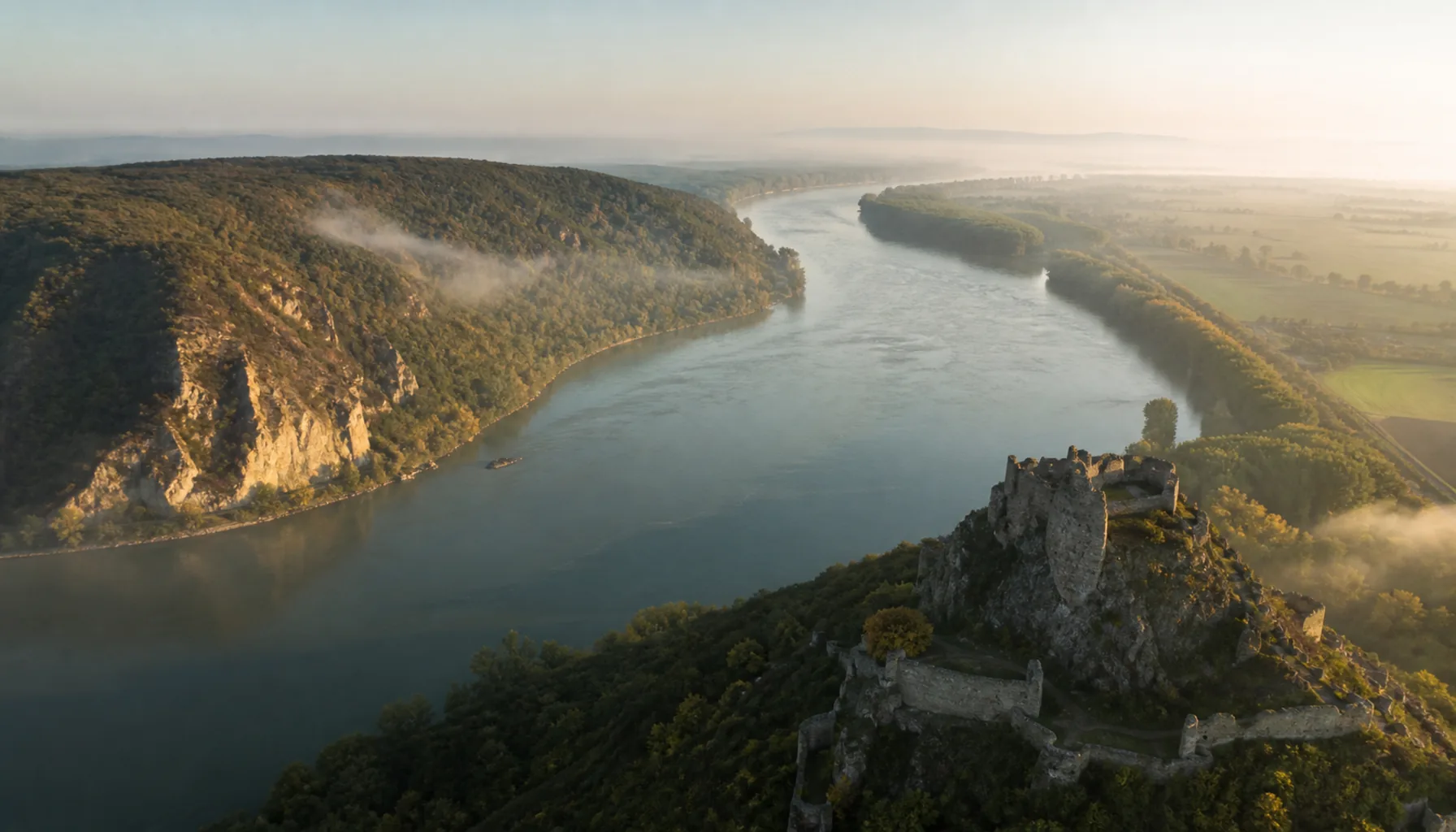
Two capital cities an hour apart, a Roman legionary town on the far bank, and a cycle path along what used to be the Iron Curtain.Dve hlavné mestá hodinu od seba, rímske legionárske mesto na druhom brehu a cyklochodník po tom, čo bývalo železnou oponou.
The Devín Gate where the Danube leaves the CarpathiansDevínska brána, kde Dunaj opúšťa Karpaty
Two capitals, one hourDve hlavné mestá, jedna hodina
Bratislava and Vienna are about sixty kilometres apart, which makes them the two closest capital cities in Europe. Trains run frequently and take about an hour, buses go from the centre and from both airports, and in season a hydrofoil runs down the Danube. Plenty of people commute.Bratislava a Viedeň sú od seba asi šesťdesiat kilometrov — sú tak dvoma najbližšími hlavnými mestami v Európe. Vlaky premávajú často a cesta trvá asi hodinu, autobusy idú z centra aj z oboch letísk a v sezóne po Dunaji jazdí rýchloloď. Nemálo ľudí takto dochádza za prácou.
The border itself is at Berg and Kittsee and is invisible. The suburbs on the Austrian side are full of Slovak number plates: property was cheaper there for years, and the pattern has not fully reversed.Samotná hranica je pri Bergu a Kittsee a je neviditeľná. Predmestia na rakúskej strane sú plné slovenských značiek: nehnuteľnosti tam boli roky lacnejšie a tento vzorec sa dodnes celkom neobrátil.
Hainburg and CarnuntumHainburg a Carnuntum
Hainburg, ten kilometres downstream from Devín, is a small walled town under a castle ruin with one of the best-preserved medieval gates in Austria, and it is the natural first stop.Hainburg, desať kilometrov po prúde od Devína, je malé hradbami obohnané mesto pod zrúcaninou hradu s jednou z najzachovalejších stredovekých brán v Rakúsku — a je prirodzenou prvou zastávkou.
Carnuntum, at Petronell just beyond it, is the reason the Romans were here at all: the legionary fortress and civilian city that governed this stretch of the Danube frontier, with reconstructed buildings you can walk into and an amphitheatre. The fort at Rusovce on the Slovak side and the one at Iža opposite Komárno belong to the same system.Carnuntum pri Petronelli hneď za ním je dôvodom, prečo tu Rimania vôbec boli: legionársky tábor a civilné mesto, ktoré spravovali tento úsek dunajskej hranice, s rekonštruovanými budovami, do ktorých sa dá vojsť, a s amfiteátrom. Tábor v Rusovciach na slovenskej strane a ten v Iži oproti Komárnu patria do tej istej sústavy.
Schloss Hof, a Baroque palace with terraced gardens built for Prince Eugene of Savoy, is a short drive north of the river and is one of the largest country houses in the region.Schloss Hof, barokový zámok s terasovými záhradami postavený pre princa Eugena Savojského, je kúsok na sever od rieky a patrí k najväčším vidieckym sídlam v regióne.
The Iron Curtain trailTrasa po železnej opone
The long-distance cycle route along the old Iron Curtain runs up the Morava from Devín through the Záhorie wetlands, with the concrete bunkers of the interwar Czechoslovak defence line still standing in the fields and, on the Austrian side, the flat wetland country of the March-Thaya floodplain.Diaľková cyklotrasa po niekdajšej železnej opone vedie od Devína popri Morave cez záhorské mokrade, pričom v poliach dodnes stoja betónové bunkre medzivojnovej československej obrannej línie a na rakúskej strane sa tiahne rovinatá mokraďová krajina nivy Moravy a Dyje.
Neusiedler See, the shallow steppe lake on the Austrian–Hungarian border, is under an hour from Bratislava and is a different landscape again: reeds, salt pans and some of the best birdwatching in central Europe.Neziderské jazero, plytké stepné jazero na rakúsko-maďarskej hranici, je z Bratislavy za necelú hodinu a je to opäť úplne iná krajina: trstiny, slaniská a jedno z najlepších miest na pozorovanie vtákov v strednej Európe.