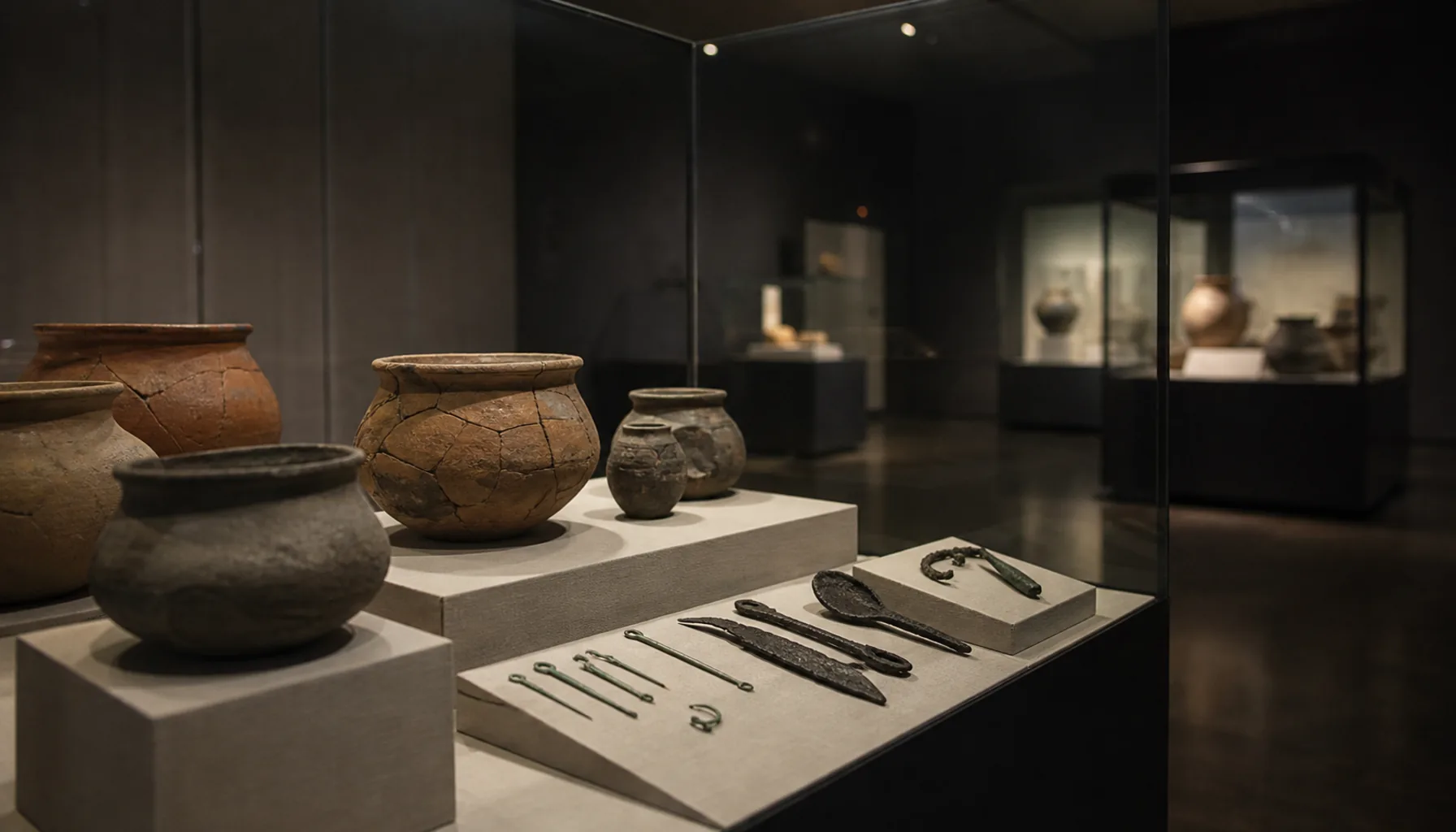
An archaeological site is not a castle. Most of them are a shape in a field or a bank under trees, with a board and no ticket office, and the objects that came out of the ground are thirty kilometres away in a museum.Archeologická lokalita nie je hrad. Väčšinou je to tvar v poli alebo val pod stromami, s tabuľou a bez pokladne, a predmety, ktoré z tej zeme vyšli, sú tridsať kilometrov ďaleko v múzeu.
Excavated pottery and bronzes in a regional museum case, where most Slovak finds end upVykopaná keramika a bronzy vo vitríne krajského múzea, kde väčšina slovenských nálezov končí
What is actually thereČo tam v skutočnosti je
The ordinary case is a hillfort. You park in a village, walk uphill for half an hour through beech or oak, and at some point the path crosses a low bank and a shallow ditch — that is the defence, and that is the site. Inside there is forest floor. In winter, with the leaves down, the shape of the ramparts reads clearly; in July it can be almost invisible.Bežný prípad je hradisko. Zaparkujete v obci, pol hodiny stúpate bukovým alebo dubovým lesom a v istom bode chodník prejde cez nízky val a plytkú priekopu — to je opevnenie a to je celá lokalita. Vnútri je lesná pôda. V zime, keď je lístie dole, je tvar valov dobre čitateľný; v júli býva takmer neviditeľný.
The lowland case is worse, in the sense that there is nothing at all. A settlement that produced tens of thousands of finds is, above ground, a field of maize with a slight rise in it. Some of the most important prehistoric sites in the country cannot be visited in any meaningful way, and it is better to know that before driving out to one.Nížinný prípad je horší v tom, že tam nie je vôbec nič. Sídlisko, ktoré vydalo desaťtisíce nálezov, je nad zemou pole kukurice s miernym vyvýšením. Niektoré z najdôležitejších pravekých lokalít v krajine sa nedajú navštíviť nijako zmysluplne a je lepšie vedieť to pred cestou.
Signage runs from a well-made bilingual panel to a rusted frame with the print gone. Where the boards are good they are often very good, with a reconstruction drawing and a plan; where they are missing, a printed map is worth more than any app, because the paths are forest paths and the rampart is not marked on them.Značenie kolíše od dobre spracovanej dvojjazyčnej tabule po hrdzavý rám s vyblednutou potlačou. Kde sú tabule dobré, bývajú veľmi dobré, s rekonštrukčnou kresbou a plánom; kde chýbajú, má vytlačená mapa väčšiu cenu než akákoľvek aplikácia, lebo cestičky sú lesné a val na nich vyznačený nie je.
The places built for visitorsMiesta pripravené pre návštevníkov
A handful of sites have been made legible, and they are the ones to start with. Gerulata at Rusovce is a roofed and walled museum around excavated masonry, with opening hours and a curator. Kelemantia at Iža is the opposite arrangement — conserved foundations in open fields, no gate, no fee, and nobody to ask.Hŕstka lokalít bola sprístupnená a sú to práve tie, ktorými sa oplatí začať. Gerulata v Rusovciach je zastrešené a ohradené múzeum okolo odkrytého muriva, s otváracími hodinami a kurátorom. Kelemantia pri Iži je opačné riešenie — zakonzervované základy vo voľných poliach, bez brány, bez vstupného a bez človeka, ktorého by ste sa mohli niečo opýtať.
Havránok above Liptovská Mara has timber reconstructions on the excavated ground and an exceptional setting. Ducové has its ninth-century rotunda and enclosure laid out in stone on the hilltop. Bratislava Castle keeps part of its excavations in an underground exhibition, and at Devín the outline of the Great Moravian church is marked where it was found. Bojná has a small museum in the village, and that is where the plaques are explained.Havránok nad Liptovskou Marou má na preskúmanej ploche drevené rekonštrukcie a výnimočnú polohu. Ducové má rotundu a ohradenie deviateho storočia vyznačené v kameni na temene kopca. Bratislavský hrad uchováva časť odkrytých nálezov v podzemnej expozícii a na Devíne je pôdorys veľkomoravského kostola vyznačený tam, kde ho našli. V Bojnej je v obci malé múzeum — a práve tam sú plakety vysvetlené.
Reconstruction is always a decision, not a discovery. A rebuilt palisade shows what a rampart might have looked like; it is an interpretation in timber, and a good site says so on the board. The consolidated ruin — stabilised, not rebuilt — is the more honest presentation and the less photogenic one.Rekonštrukcia je vždy rozhodnutím, nie objavom. Obnovená palisáda ukazuje, ako val mohol vyzerať; je to výklad v dreve a dobrá lokalita to na tabuli aj povie. Konzervovaná zrúcanina — spevnená, nie dostavaná — je poctivejšou prezentáciou a menej fotogenickou.
Where the finds areKde sú nálezy
The objects are in museums, and that is where an archaeological trip in Slovakia usually earns its keep. The Archaeological Museum of the Slovak National Museum in Bratislava holds the national collection. Each kraj museum shows what came out of its own districts, so the Bronze Age of the Nitra region is displayed in Nitra and the Roman material from Iža in Komárno.Predmety sú v múzeách a práve tam sa archeologický výlet na Slovensku obyčajne vyplatí. Celoštátnu zbierku spravuje Archeologické múzeum Slovenského národného múzea v Bratislave. Každé krajské múzeum ukazuje to, čo sa našlo v jeho okresoch, takže dobu bronzovú Ponitria uvidíte v Nitre a rímsky materiál z Iže v Komárne.
Storage is the other half of the truth: only a small proportion of what is excavated is ever displayed, and the star pieces travel to exhibitions. The Moravany figurine is the case in point — famous, reproduced everywhere, and not reliably on show anywhere. Check before making a special journey for a single object.Druhou polovicou pravdy sú depozitáre: vystavená býva len malá časť toho, čo sa vykope, a najvzácnejšie kusy cestujú po výstavách. Moravianska venuša je toho príkladom — slávna, všade reprodukovaná a nikde spoľahlivo vystavená. Ak idete kvôli jedinému predmetu, overte si to vopred.
Rules, and mannersPravidlá a slušnosť
Archaeological finds in Slovakia are the property of the state, and searching for them with a metal detector on a site, without a permit, is against the law. This is not a formality: detectorists have done real damage here, and they have also made real discoveries, including some of the most important ones. The difference lies entirely in whether the find was reported and recorded where it lay.Archeologické nálezy sú na Slovensku majetkom štátu a vyhľadávať ich detektorom kovov na lokalite bez povolenia je protizákonné. Nie je to formalita: hľadači s detektormi tu narobili skutočné škody a zároveň urobili skutočné objavy vrátane tých najdôležitejších. Rozdiel je len v tom, či bol nález nahlásený a zdokumentovaný na mieste, kde ležal.
If something does come out of the ground in front of you, the useful response is to leave it where it is, photograph it, note the spot and tell the regional monuments office or a museum. An object without its context is a curiosity; an object recorded in place is evidence.Ak vám niečo zo zeme vyjde priamo pred očami, najužitočnejšie je nechať to ležať, odfotiť, poznačiť si miesto a ohlásiť to krajskému pamiatkovému úradu alebo múzeu. Predmet bez súvislostí je kuriozita; predmet zdokumentovaný na mieste je prameň.