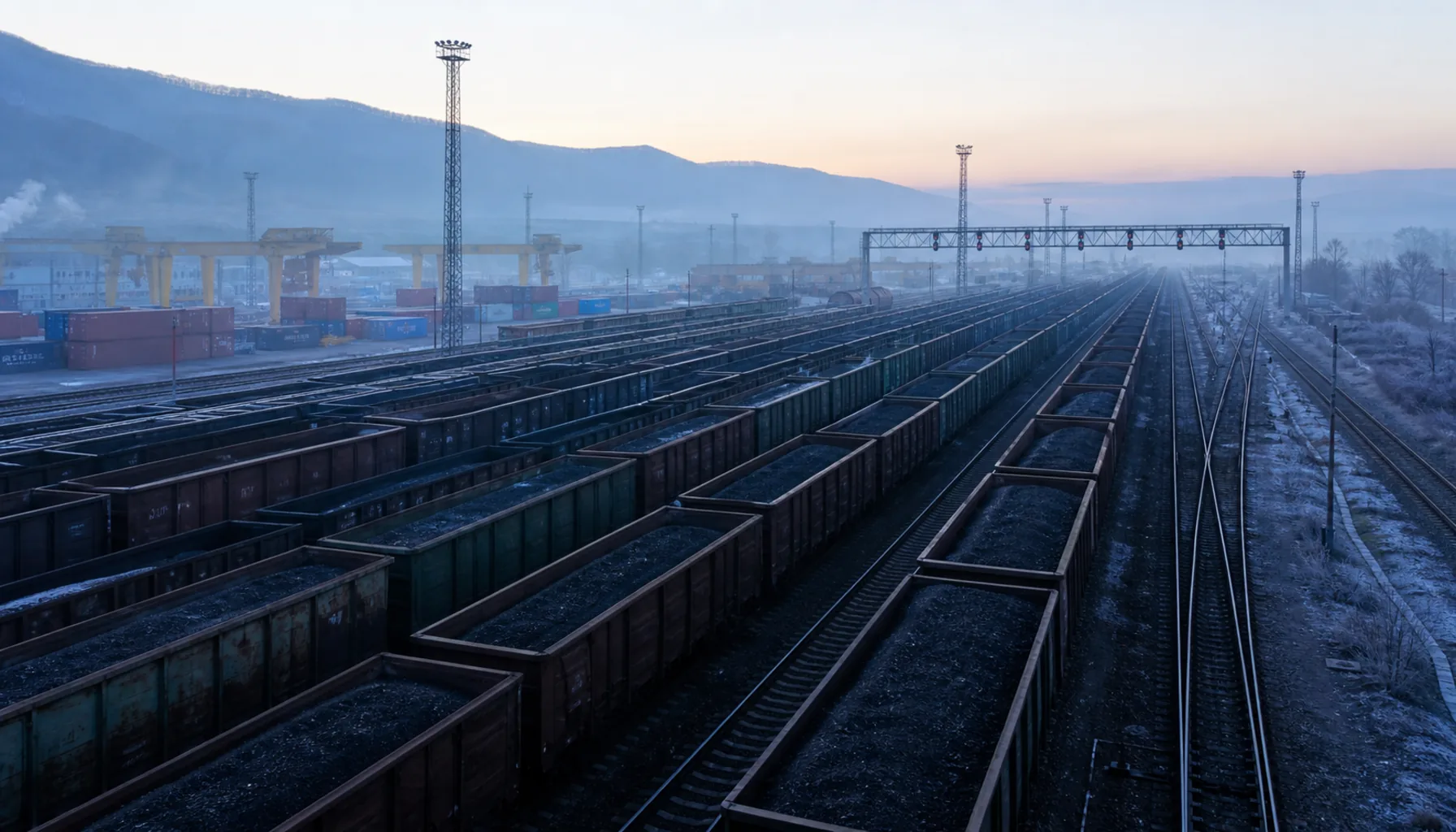
A landlocked country that everything crosses: the north–south motorway between Poland and Hungary, the east–west corridor to Ukraine, a Danube port, and the westernmost broad-gauge railway in the European Union.Vnútrozemská krajina, cez ktorú prechádza všetko: severojužná diaľnica medzi Poľskom a Maďarskom, východozápadný koridor na Ukrajinu, dunajský prístav a najzápadnejšia širokorozchodná železnica v Európskej únii.
Freight wagons in the yard at the broad-gauge terminal near KošiceNákladné vagóny na širokorozchodnom prekladisku pri Košiciach
How big it isAké je to veľké
Slovakia is long, narrow and mountainous, which makes transport both its advantage and its permanent construction site. Bratislava is within a short drive of Vienna, Brno and Győr; Košice is closer to Kyiv than to Prague. Everything between them has to cross ranges that run the wrong way for a road.Slovensko je dlhé, úzke a hornaté, čo z dopravy robí zároveň jeho výhodu aj trvalé stavenisko. Z Bratislavy je kúsok do Viedne, Brna aj Győru; Košice sú bližšie ku Kyjevu než k Prahe. Všetko medzi tým musí prekonať pohoria, ktoré sa tiahnu pre cestu nesprávnym smerom.
The result is that logistics is not a niche here but a structural industry, and the warehouse parks that ring Bratislava, Nitra, Trnava, Žilina and Košice are as much part of the landscape as the car plants they feed.Výsledkom je, že logistika tu nie je okrajovým odvetvím, ale štrukturálnym priemyslom, a logistické parky obopínajúce Bratislavu, Nitru, Trnavu, Žilinu a Košice patria ku krajine rovnako ako automobilky, ktoré zásobujú.
Where it happensKde sa to deje
The D2 runs north–south from the Czech border through Bratislava to Hungary and is the busiest freight axis. The D1 runs west–east from Bratislava towards Košice and has been under construction, section by section, for the whole independent history of the country; the mountain stretches through Turiec and Šariš are the hard part. The D4 and R7 around Bratislava were built to take transit traffic out of the city.D2 vedie zo severu na juh od českej hranice cez Bratislavu do Maďarska a je najvyťaženejšou nákladnou osou. D1 vedie zo západu na východ z Bratislavy smerom na Košice a stavia sa úsek po úseku počas celých samostatných dejín krajiny; ťažké sú horské úseky cez Turiec a Šariš. D4 a R7 okolo Bratislavy vznikli preto, aby vyviedli tranzit z mesta.
The railway network is dense — a legacy of the Habsburg and then the Czechoslovak state — and still carries a high share of freight by west European standards. The broad-gauge line is the oddity: a 1520 mm track running from the Ukrainian border to Haniska near Košice, built to feed the steelworks with iron ore without transshipment, and the westernmost such line in the Union.Železničná sieť je hustá — dedičstvo habsburského a potom československého štátu — a na západoeurópske pomery stále vezie vysoký podiel nákladu. Zvláštnosťou je širokorozchodná trať: koľaj rozchodu 1520 mm od ukrajinskej hranice do Hanisky pri Košiciach, postavená na dovoz železnej rudy do hutí bez prekládky, a najzápadnejšia trať svojho druhu v Únii.
Water and air are smaller. The Danube carries barge traffic through the ports of Bratislava and Komárno; Bratislava airport handles passengers and cargo, with Košice, Poprad-Tatry and Piešťany serving their regions.Voda a vzduch sú menšie. Dunaj nesie riečnu nákladnú dopravu cez prístavy Bratislava a Komárno; bratislavské letisko odbavuje cestujúcich aj náklad, Košice, Poprad-Tatry a Piešťany slúžia svojim regiónom.
Who does itKto to robí
The state railway is split three ways in the European manner: infrastructure, passenger operations and freight are separate companies. Private freight operators run alongside them and have taken a substantial share, particularly on the bulk flows.Štátna železnica je rozdelená na tri časti podľa európskeho vzoru: infraštruktúra, osobná doprava a nákladná doprava sú samostatné spoločnosti. Popri nich pôsobia súkromní nákladní dopravcovia, ktorí získali podstatný podiel najmä pri hromadných substrátoch.
Road haulage is dominated by domestic small and medium firms — Slovak plates are a familiar sight on every motorway in Europe — with the international integrators operating the distribution centres. The car plants pull the rest of the system into shape: a just-in-time supply chain across four assembly plants sets the timetable for a great many trucks.Cestnej nákladnej doprave dominujú domáce malé a stredné firmy — slovenské značky sú bežným pohľadom na každej európskej diaľnici — pričom distribučné centrá prevádzkujú medzinárodní integrátori. Zvyšok systému formujú automobilky: dodávateľský reťazec just-in-time naprieč štyrmi montážnymi závodmi určuje harmonogram veľkému množstvu kamiónov.
What is changingČo sa mení
The D1 will eventually be continuous, and every government since 1993 has promised a date. Rail electrification and the upgrade of the Bratislava–Žilina–Košice corridor matter more for freight than any single motorway section.D1 raz bude súvislá a každá vláda od roku 1993 sľúbila termín. Pre náklad je však elektrifikácia a modernizácia koridoru Bratislava – Žilina – Košice dôležitejšia než ktorýkoľvek jednotlivý diaľničný úsek.
The eastern border became a different kind of place after 2022 — a humanitarian and then a logistics corridor into Ukraine — and the broad-gauge terminal at Haniska has been discussed for years as a wider east–west transshipment hub. Whether that happens depends on things well outside Slovakia's control.Východná hranica sa po roku 2022 zmenila na iné miesto — najprv na humanitárny, potom na logistický koridor na Ukrajinu — a o širokorozchodnom termináli v Haniske sa roky hovorí ako o väčšom prekladisku medzi východom a západom. Či sa to stane, závisí od vecí ďaleko mimo dosahu Slovenska.